Tuele Hospital

Friday, 22 March 2019

Zanzibar – Watching the tide roll in….. then I watch it roll away again.


My body and mind are confused. I am in one of the most beautiful places on Earth, perfect for relaxing and chilling out (something I have always been very good at) but for some reason, I feel unsettled. My mind and spirit feel elsewhere. It is taking all of my practiced determination to let go of such debilitations and enjoy the time we have here.

Tucked away in the tropical garden
For the last few days of our stay on Zanzibar we have moved to a little self-catering cottage complex on the South of the island. A big step down in terms of ‘luxury’, this is certainly a good stepping stone to reclimatisation in Muheza. It has none of the opulence of our previous accommodations and its beauty lies in its simplicity and integration with the natural surroundings. It is a stunning and delightful place, set just back off the beach in a tropical garden designed for shade. It has many little pergolas and our favourite is up on stilts catching the full force of the sea breeze which certainly takes the edge off the heat. From here, you look down out over the sea and can watch the tide rolling in and out. Very calming.
Our favourite spot - lovely breeze, great views. and Morning Tea


The breeze also keeps the mosquitos away, of which there are plenty. On our arrival it was a bit of a shock to find our cottage with unnetted windows and teeming with the blighters – more mosquitos than I have seen since arriving in Tanzania. But Zanzibar has almost eliminated malaria and so it is more the irritation than a health risk as such. Closing the shutters and a quick fumigation of the entire building before we went out in search of supper was very effective. On our return it was ‘safe’, if not a little aromatous, with not a single biter in sight (except lying in state on the floor)! 
I think we will have a lovely few days here.
I have also received great news from Muheza. The two laparotomies from last week are recovering well and the service continues to thrive without me. Even in the face of staff bereavement and medical student examinations, they have managed to do a mesh hernia repair independently. Woohoo! I am chuffed to bits.


Wednesday, 20 March 2019

Zanzibar - Diving


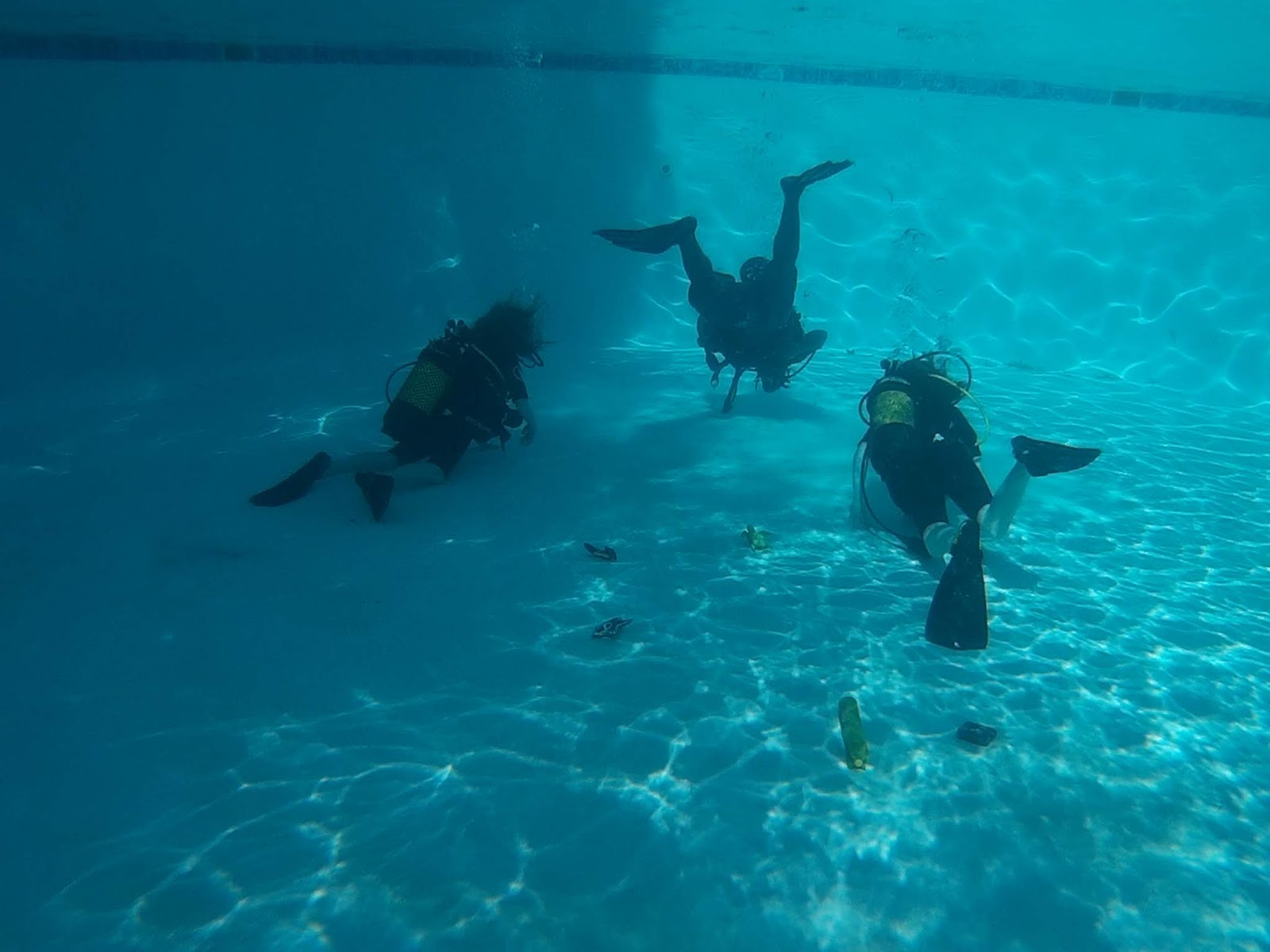
Up on the north of the island, the focus of the last few days has been diving. Opposite the well known Mnemba island dive sites, it might have been considered rude not to go. On Monday afternoon we were picked up and taken by boat to the dive centre a little further up the coast for a pool session. Whilst my wife and I are PADI certified, it has been many years since either of us had dived (children do that to you) and we both felt that a refresher would be a good idea. Also, our eldest daughter was old enough to do an ‘Introduction to diving’ course which meant that after a short pool based tutorial she would be able to dive with us on the reef too! This is not a PADI certification as such and means that in the water she has to be buddied with a dive master or certified instructor and is limited to 12m in depth. Whilst technically this limited what we could do, neither of us minded as the opportunity for her seemed too good to miss (there can’t be many 11 year olds that have actually dived on a coral reef). 
Also, my brilliant wife had discovered that there is a diving taster that our middle daughter could do; “Bubble-blower” who knew there was such a thing. This meant that she had an hour in the pool learning to dive. Fantastic. The team there were very sweet and at the end of this pool session they put a child’s mouthpiece on my spare regulator and let our youngest daughter swim with me on the surface with her head in the water breathing through the regulator to get an experience too. All three of them were absolutely thrilled!

Middle daughter learning. Older two in the deep end playing with the instructor. Our youngest loving it too!
Our original plan had been to go diving together on the Tuesday, but both of us had independently woken up in the night and decided that we could not leave our younger two children in the care of the hotel staff. Whilst they were lovely, it just did not feel right to either of us. So on Tuesday my wife and eldest went off for an amazing diving experience together. I had a fun time with the younger two in the three hotel pools – tough I know!

Having returned extolling the amazing experience that they’d had (including two dolphins that came to them underwater), it was arranged that I should go on Wednesday. I was not to be disappointed. I was treated to an amazing array of fish (lion, angel, stone, puffer, moray, flat and a host of others that I cannot name – including some incredible camouflage experts) as well as some pretty good coral (it was good to see the reef alive, if not thriving). Somehow, in all of that, my eldest daughter managed to negotiate a second day of diving, which meant that she spent nearly 4 hours underwater in total. 


Eldest daughter in the Indian Ocean

Very well disguised flat fish - its most of the top of the rock

I remembered we should pose for a photo!

Moray eel


Monday, 18 March 2019

Zanzibar – Expanding Horizons

Zanzibar is every bit as idyllic as it promised to be. Exploring Stone Town at the weekend was fascinating, not least because a visit to the slave museum provided a gripping insight into the far from idyllic history of the island. One of the main ports for slave export from the continent of Africa, the museum holds a harrowing account of what humans are capable of doing to one another. It is remarkable to think that the tail end of this industry continued into the 1920s.

One of the three pools
After lunch, we said goodbye to my wife’s uncle – his schedule only allowed a very brief visit – and we set off for our hotel on the northern tip of the island. The SeVi Boutique Hotel is truly magnificent. It overlooks a beach which has sand of the most remarkable quality. It is so white and so fine, it is almost like walking upon flour. The hotel ‘complex’ is extensive with three pools and the modern twist on traditional bandas (thatched huts) is delightful. We have our own family house (complete with a personal plunge pool) and are being treated to genuine luxury for a few days. As almost the only guests here (we are very close to the start of the rainy season and so most hotels start to close down for a couple of months) it is also delightfully quiet. All the hustle, bustle and constant ‘best price, very good price, cheapest taxi’ of Stone Town thankfully behind us. 

Our beach cottage - the whole thing! and The bed greeting us!

Over the past few days, I have also had some space and time to think about and discuss a number of ideas that have been evolving over these past few months. I am immensely proud of the work we have done in Muheza and do believe that many of the developments we have worked upon are sustainable. Furthermore, the new local links and commitment for ongoing collaboration that emerged will be invaluable for the hospital. All these things will make a big difference to the quality and safety of the surgical service provided in Muheza. So in many ways, I could walk away in a couple of weeks’ time and justifiably feel that not only has our time here been worthwhile, but that we are leaving behind a valuable legacy too.

However, these five months have opened my eyes and given me a much deeper understanding of global healthcare. This experience has ignited within me a fascination and passion to do more. I have learned so much during my time here and my unexpected travels within Tanzania have further uncovered abundant potential opportunity. There is much that Western practice (and life in general) can learn from countries such as Tanzania, and there is of course so much more that can be done here to ‘raise the bar’ and narrow the gap in global healthcare provision. Having dipped my toes in the water (and perhaps immersed myself in the depths for a short while) I would like to continue to be involved.

When I return to the UK in a few weeks’ time I hope to continue to support and expand the work we have started here. Through my eyes as a surgeon, clinically such things seem eminently possible. Of course this may be ambitious, expansion will require many different resources and also greatly increases complexity. It will be challenging. But many steps have already been made towards such an endeavour and my network of contacts and willing help is growing. Through sustained and co-ordinated collaboration, I believe we can continue to help the productive development of surgical services here. Now, I just need to lay out my proposals in a more formal fashion and to begin to find ways to fund all this future work.

Best not to get bored on holiday!


Sunday, 17 March 2019

Zanzibar - Reverse Culture Shock

My wife’s Uncle arrived safe and sound very late on Friday night and it was an absolute delight to welcome him to our home. Although our original plans were for a traditional Tanzanian supper with all the family (cooked by our house keepers), the childlers were long fast asleep by the time he arrived. We had saved him a plate of food; pilau, goat stew and a spinach like vegetable dish. It may not sound it, but it really was delicious. We enjoyed a beer and lots of conversation, clearly there was so much to talk about. I think it was the latest night we’ve had here!

After a breakfast of fruits, pancakes and Tanzanian coffee; on Saturday morning he was ‘treated’ to an immersive African experience. The children had given a lot of thought to what to show him for the morning we had in Muheza. They took him on a guided walk through the fields and local shambas (mini-farms), then into town to see the market and finally I would take him round the hospital.

It was really brilliant to show him where we have been working these last few months. I felt a strong sense of attachment and pride as we walked round. I talked him through the layout and organisation of the hospital as well as describing the day to day activities. Although it was Saturday, there were plenty of people around. It was also Kids Club at the Hospice which was great for him to see. This is an amazing weekend initiative that offers children with HIV breakfast and lunch as well as lots of games, whilst squeezing in their regular clinic appointment. It has provided an incredible support network for them and encourages compliance with treatment. Despite their diagnosis, these are now ‘healthy’ children which is quite amazing really.

I realised as we walked around, quite how much a part of Muheza hospital we have become in our time here. I introduced the various staff working and many others who were passing through the grounds (all in Swahili I am proud to say). I have become very fond of this place and am so pleased that we came to work here. We have achieved a lot. However, guiding a new pair of eyes around also reaffirms just quite how much more there is that could be done. The rusty and wonky beds, the dubious mattresses, the collapsing bedside tables, the tired paint, the building works in progress (not to mention the lack of ITU and anaesthetic equipment, the very tired x-ray machine and a host of other things). The tour concluded and I think we both had much to think about. It was a very informative experience for all. Hopefully, we can continue to support the growth and development of healthcare services here. I pointed the ‘tour group’ in the direction of home, whilst I briefly returned to the wards to see my post op patients.

It was then an early lunch and off to the airport in Tanga. We had a 14.15 flight to Zanzibar! This was a trip that I have been so looking forward to – an anticipated escape and reward that has enabled me to knuckle down and get on with things these last few weeks.

The flight itself was delightful. We walked out of the small terminal onto the runway to be greeted by our small single prop plane that could carry 12 passengers. The Top-Gun-esque Indian pilot dressed in pristine whites and golden epaulettes (with the compulsory shades of course) spoke the Queen’s English and took very good care of us. It was amazing to see the region from the air and to fly over our regular weekend beachside retreats.


We had arranged to stay one night in Stone Town before moving on to two ‘beach resorts’ at either end of the Island. Treated to this holiday, we would be staying in some very nice hotels and would see another very different side to Tanzania. Arriving at our hotel in Stone Town was a slightly strange and surreal experience for me. 
The Tembo Hotel oozes Afro-Indian style opulence. I smiled broadly as we walked through the large, dark wooden, brass studded doors, to a foyer housing reception. This led straight out to a courtyard with a pristine marble fountain, luscious plants and that very inviting and soothing sound of trickling water. But then as I walked through the hotel, past the swimming pool and bar to the beach, I found myself quite overwhelmed. I had stepped into another world and was surrounded by affluent and scantily clad Wazungu (not all of them could carry it off), who were lounging in the sun sipping various cocktails. 
I suddenly felt very uncomfortable being immersed into such an environment. So many white people! All clearly having an excellent time. But their time seemed such a world away from what our lives have been these last few months. It was surprisingly difficult, and I now understand the meaning of ‘reverse culture shock’.

But this is all part of the rich experiences of life. Whilst on the one hand you could spend hours unpicking the social injustice of it all, such an approach is often not very productive and certainly wouldn’t help me to enjoy the holiday I was going to be having regardless of how I was feeling. The girls were all beside themselves with delight I am pleased to say. I took a deep breath, took a brief time out by walking along the beach and threw myself into the fun that I knew we all needed.

A beer also helped.

Whilst the hotel did not serve alcohol, there was a bar 10m down the beach that did. I enjoyed a cold bottle of Kilimanjaro and relaxed into my surroundings whilst the children were making the most of the hotel pool. When it came to paying the bill, the 6,000TZS price tag made me stutter. Whilst just a little over £2, it was 3x the price of what you would pay in Muheza. I found myself playfully commenting in Swahili how expensive the beer was, which delighted the waitress (clearly very, very few Wazungu ever even try to speak the native tongue). She empathised, and this led to a short conversation. I surprised myself by my near fluency in understanding the fact that this was a tourist bar, not a local bar (where beer was much cheaper), and then by explaining where we had come from and what we have been doing in Tanzania. This impromptu dip back into my Tanzanian reality was in fact extremely therapeutic for me and I walked back to the hotel ready to embrace the next few days and enjoy them.


Friday, 15 March 2019

Pound of Flesh


Today is Friday, a day we try to reserve for emergency operating only. Recently, our elective work has spilled into Fridays, but having been very efficient this week I was looking forward to an easier day. We had no planned cases. The morning meeting was uneventful and walking to the wards, I was thinking that it might be a fairly quick round and then an early lunch. I was planning to head to Tanga in the afternoon to do some shopping before picking up my wife’s uncle from the airport who was coming to visit us. All the arrangements to borrow the Hospice car had been made.

Predictably though, as often happens in surgery, things would not be anything like so straight forward. Perhaps I jinxed it as I headed to the wards, noting that we had not had any big cases recently. No laparotomies for a while. Today we would end up with two!

I walked onto the female ward and met up with one of the local surgeons (they tend to split the wards between the two of them). I saw our post-ops who were all doing really well. Great. I was about to leave when he said “Dr Mak (their take on my name)…. I want you to see this mama” (‘mama’ is the Swahili word for ‘mother’, but also the way to describe or address any ‘middle-aged’ woman). I smiled and turned around. I was taken to see one of the few obese Tanzanians I have been asked to review during my time here. She was being quite vocal about her pain (I had noted this when I entered the ward earlier) and was rolling around on her bed. In my experience as a surgeon in the UK, you have to be quite careful with such patients, some might simply be a little histrionic and it is best to be cautious about proceeding with potentially life changing decisions such as surgery. However, I have also learned to remain very open minded.

On my review, I could see that she was uncomfortable. Assessment of her abdomen was tricky given her ample covering (obesity does genuinely make the clinical assessment of the abdomen difficult). However, I could feel a large epigastric hernia which was slightly tender. Putting everything together, felt she warranted surgery. I did not make this decision lightly (to be honest I didn’t really want to operate today, and certainly not on what was likely to be a difficult case (obesity also makes the technical aspect of our job more challenging). But it was the right thing to do. In the UK I would have put her through a CT scan first (which interestingly would have been very helpful as will become apparent later) but that was not an option, so we booked her for theatre.

As I walked to the male ward, I gave myself a little pep talk. Whilst my day had become more complicated, the operation was very necessary and I reasoned that I could get it done and still get away at a reasonable time if we were efficient.

Pleasingly, all our post-ops on the male ward were also doing great and I discharged a few. The discharge paperwork is so much easier here, an A5 piece of paper with only the essential information. Beautifully informative by being succinct, and in my opinion, much better than the now onerous systems we have in the UK. Just as I completed the final instructions outlining the requirement to return to the outpatients for follow up, the other local surgeon spoke up. “Dr Mak. I want you to see one patient”. I looked up and again I smiled. What would this be.

It turned out that the patient was about to be transferred from another ward. We walked out of the door to go there, but pushed by a nurse they met us weaving precariously on one of our hospital wheelchairs. On the positive, we do have a few wheelchairs. Unfortunately, they are all a bit tired and tend to behave like mischievous shopping trolleys.

The fact that this 36 year old man was transferred in a chair was a useful clinical sign in its own right, it implied that he was definitely not well. The transfer from chair to bed was also clearly a trial for him, but a certain pride here often prohibits the acceptance of any help. We read the notes and the suspicion of the doctor who reviewed him this morning was that he had bowel obstruction. A brief history certainly suggested this too. I examined his abdomen and it was tense like a drum. He was also tender (a bad sign suggesting pending, if not already occurred, catastrophe). Inwardly, I confess, I sighed as I vocalised what I knew was my duty to this man. He also needed a laparotomy. My day was becoming very complicated.

An x-ray would have been useful, but the machine was out of action being treated to a refurbishment of the ‘suite’ that houses it (perhaps a little encouragement for it to stay alive). This absolutely epitomises my experience here. Devoid of the many investigative comforts that I enjoy in the UK, I have learned to confidently work as a clinician in the truest sense. All the sophisticated tests to which I might normally turn to add another piece to the diagnostic puzzle are absent. I pretty much rely upon only those which I can perform with my own hands. Surprisingly, I have been very comfortable with this. Certainly experience counts for a lot, and I also suspect that having had access to such tests in the past, I have learned so much from them and am now able to almost predict and visualise what they might show. Undoubtedly, modern sophisticated investigations might have changed many a patient’s pathway in some way, but I have also learned that you can do a huge amount without them. He too was readied for theatre.

The first lady was on the operating table at 11am. My clinical findings on the ward were sound as I dissected and defined a rather large epigastric hernia (this means the hernia originated between her belly button and breastbone). It was about the size of a large grapefruit. It contained a bruised loop of transverse colon, which I concluded could probably account for her symptoms. However, I was clear in my mind before the operation that I would want a proper look at the inside of her peritoneal cavity (in other words get a really good look inside her tummy) to be sure that there was no other mischief. The neck of the hernia was tight (this means that the hole in the abdominal wall was small compared with what had come through it) in keeping with the bruising to the bowel, and I had to enlarge it to get the bowel back inside safely. This also meant that I had a good ‘window’ to inspect what I needed to. I could see no other obvious issues.

However, I have been taught to be thorough and I used my hands to assess by feel what I couldn’t see. Just as was about to affirm ‘the all clear’, I checked the anterior abdominal wall. My fingers found what I immediately knew to be a second hernia at her belly button, about 4cm below where the bottom of the current hernia defect ended. This is interesting, as it is actually quite unusual to have two separate significant problems at such an operation. Furthermore, given her ample covering, this hernia was completely hidden from clinical examination – genuinely, I still could not feel it even when I knew it was there. However, the compressed sausage like contents that I could assess between my fingers were undoubtably a loop of small bowel entering this second abnormality. And they were very stuck. If I had just pulled harder, the bowel would have torn spilling its contents all over the abdomen which would have been disastrous. I explored this second area, dissecting it out and opening up the ring of tissue that was like a noose around this loop of bowel (this hernia turned out to be a little smaller than a golf ball). Unfortunately, it had been strangulating that knuckle of bowel for too long and it was dead. It needed to be resected (chopped out). I removed it, joining the two healthy cut ends of bowel back together with lots of individual stitches (an end to end, interrupted, handsewn anastomosis). It would have been so easy to miss this second problem and I am very glad that I didn’t. I suspect if I had, she probably would have died. As it is, she still needs to heal the join in the bowel that I have made and recover from this ordeal.

One down, one to go.

The second case was no less challenging than the first. On opening this man’s abdomen, an enormous loop of colon burst forth explaining the drum like quality that his abdomen presented on the ward. It was like an unwieldy python, about the diameter of a saucer and close to bursting. Massive. A sigmoid volvulus is where part of the colon twists upon itself causing what we call a ‘closed loop’ obstruction (both ends are blocked off, in this case by the twist). This is a big issue as the bowel will continue to distend (as it continues to produce mucus and gas) until it ruptures. I was not surprised to find such a problem, it was one of the more likely differential diagnoses I had considered. Fortunately, whilst impressive, it had not yet perforated which meant that the situation was potentially much more salvageable than if it had. Whilst in the UK I would have managed such a case very differently (using options such as endoscopy), with my hand somewhat forced, we performed a sigmoid colectomy.

Thankfully, it went very well. I decompressed the bowel first and untwisted the 360° rotation, but it was still an impressive loop of colon that I needed to resect. Once again I joined the two cut ends of bowel back together. It was not an easy join as there was a size discrepancy between these ends (I could go into a lot more technical detail here, but will resist). But the ends were healthy and taking a lot of care to produce the best possible anastomosis, the result was very pleasing.

With any bowel anastomosis (join), there is always a risk that it might not heal properly. If this occurs the bowel effluent leaks into the abdominal cavity and can make the patient very sick. Here I suspect if such a thing were to occur they would be extremely unlikely to survive.  No matter how good it looks at the time, this risk is ever present. Classically, problems arise around day five post-operatively, so it is always a slightly anxious period whilst the patients recover. However, I had done all that I could and just hope that they will recover smoothly.

During this last case my phone rang. It is always slightly surreal to dip back into another area of your life when you are elbow deep inside someone’s abdomen. I was halfway through making the join and I paused whilst my phone was answered and then held to my ear. Unfortunately, my wife’s uncle had missed his connecting flight as customs had been busy and would now be travelling by taxi from Dar es Salaam. This is far from ideal as he would be on the roads late at night, but with very tight schedules, it was necessary. It however also removed any possible time pressure from me as I would not need to travel to Tanga now after all.

As I walked home at about 5pm, I reflected on what had been a challenging, albeit very satisfying day. The team had performed brilliantly in difficult circumstances and I felt that we had ‘played our A-game’ today. A most satisfying culmination of all my time here perhaps. Feeling now very tired, I also came to the conclusion that I have very definitely given my ‘pound of flesh’ to Africa. We have done some great work, many fantastic cases, but it has been very tiring too. I have invested a lot of me here during our time here. 
I breathed a massive sigh of relief-mixed-satisfaction for my work and turned my attention to the coming week. With the arrival of my wife’s Uncle, comes a very special treat for us. We are off to Zanzibar for our final ‘holiday’ before we leave.

Thursday, 14 March 2019

Heartbreak High


This morning I woke up in the convent in Korogwe to the ringing of bells at 6am and the beautiful singing of the thirty or so nuns in the chapel opposite our dorm. It was a running day (I had even packed my kit) and so sneaked out of the room in the evolving light, leaving my eldest daughter sleeping (we had split into two rooms, one adult in each). I was greeted by a few of the nuns not in church (presumably catering for us) and they certainly had a smile of interested bemusement on their faces (I have long come to accept that my particularly white Mzungu legs attract such a reaction).

I set off in the relatively cool breeze (hot for the UK) and ran out into the country side then along the dust road into a village. This proved to be an excellent decision as I was clearly a delight to the local children all walking to school. Every day between about 06.15 and 06.45 there are droves of children all over the country walking to school on their own. Some are quite little (certainly smaller in stature than my nearly 6 year old). If they are lucky, they have an older sibling to walk with, but many do not. They are all beautifully dressed, looking very smart – white shirts, bright jumpers and usually dark skirts / shorts / trousers. Although on closer inspection you can see the holes and repairs in the uniforms or the very worn shoes that most of them wear. They often carry large containers of water or firewood or twig brushes for cleaning. Clearly education is highly valued, and the local environment considered safe. I cannot recall how many times I replied “marahaba” to their respectful greeting of “shikamoo” (accompanied by lots of giggles), but I certainly felt like a celebrity. For whatever reason, I have not attracted this much attention elsewhere when I have been out running. At one point I had collected a little flock of followers, all running behind me. In some ways, I wish I had had a camera. But equally you can never quite adequately capture such things on film. It is a delightful mental image to carry away with me. Another highlight of my time here.

I returned to the convent, a hot shower (ironic that for once I didn’t want it, cold was blissful), a delicious breakfast and then it was off back to Muheza.

Sometimes I feel that I am reliving the same emotionally draining experiences time and time again here. Today was another such episode.

Having seen all my pre and post-op patients for the week (all doing pleasingly well), I was asked to review another patient on the ward round. A man in his 70s, I was told he had ‘some itching around his bottom, then developed a wound’. Great I thought, this sounds like a colorectal theme (my area of specialist UK practice). I was however slightly bemused by the sparse account of the story, which to be honest shed very little light onto what we might find. It dramatically underplayed the situation. He laid on the bed to reveal an extensive perianal ulcer that could only be a squamous cell cancer. My mind was racing. This is an area of sub-specialist interest for me. In the UK centre that I worked before coming to Tanzania, we performed salvage surgery for such cases. These are big operations and we work closely with the plastic surgeons to reconstruct anatomy using clever flaps of tissue. However, I was getting ahead of myself, because even apparently extensive tumours like this can respond dramatically to targeted chemo-radiotherapy. In the UK the cure rate in such situations is surprisingly good.

But even as these thoughts were passing through my mind, accompanying them were the almost inevitable responses I knew I would hear. But I didn’t want to hear them.

The Specialist Surgeon Nun had returned with us to Muheza and she was also present on the rounds. This was particularly useful for me as she would be considered an expert in what was available for surgical diseases such as this in Tanzania. Unfortunately, she confirmed what I already suspected. Yes, the only centre that can offer chemo-radiotherapy would be Dar es Salaam. However, I established that it would be nothing like the service that I would take for granted in the UK. I tentatively asked if the patient could travel there. Everything was explained to him and his reply was quite clear.

No. That would not be an option for him.

I felt my heart sink once again. It is genuinely painful. I find myself again confronted with a situation where I have all the knowledge and skills to manage this difficult situation, but none of the support teams, drugs, nor equipment. I feel helpless. Whilst I can confidently diagnose and offer theoretical options for this poor man’s predicament, circumstance means that there is precious little I can do to actually help him. He might be cured in the UK. Here…..

We discussed a defuntioning colostomy (this means that the bowel is brought onto the skin and the effluent collected in a bag rather than passing through the anus). In situations such as this, it is a palliative procedure to try and improve his quality of life. Whilst currently he is just about managing to pass stool through his bottom, it is only a matter of time before such things become either unbearable or impossible. The local and visiting team both felt that this surgical procedure should happen. I was slightly reluctant given that currently his symptoms were manageable. But in no uncertain terms it was made quite clear to me that his best option would be for me to perform the procedure before I leave. But I have not much longer left now. The decision must always ultimately lie with the patient. I was certainly clear that I would not do it today. We are away next week, but should he want it, I could do it on my return in a fortnight.

He wants it.


Wednesday, 13 March 2019

The Elusive Appendicitis


It transpires that appendicitis in Africa is actually quite unusual. As a surgeon working in a District General Hospital (DGH) in the UK, we would expect to have several (perhaps 3-5) confirmed cases per week. It is certainly considered one of the most common surgical emergencies in the West. The population we serve in Muheza is comparable to that of a DGH back home, but I was yet to see a single confirmed case in my nearly 5 months here. Until today.

It would not be unreasonable to wonder if we were just missing them for one reason or another, but I now understand that this paucity of such pathology is entirely consistent with others experience. Furthermore, I had reluctantly taken on about 6 cases of ‘suspected’ appendicitis during my time here (whilst my scepticism was valid, to have a look was really the only ‘safe’ option), performing exploratory laparotomy. All had normal appendixes (although the local surgeons commented on how long the structures were).

And then today I was taken to see a 16 year old lad who was unwell. He had been admitted for a couple of days already, but for whatever reason, I had not been asked to see him until now. It did not take me long to establish that he was peritonitic (this means the findings of abdominal examination were very concerning). Whilst the signs were by no mean typical of appendicitis (his tenderness was in the ‘wrong’ place), he clearly warranted surgery. I probably ought to say that these decisions are entirely based on clinical judgement here, there are no other tests easily available. I had asked for an FBC (full blood count) as the machine is now fixed, but it was not forthcoming. I also probably ought to say that it would be easy to dismiss such symptoms and signs (perhaps why I had not been asked to review him sooner). The population here is incredibly stoical, and to complain of or show pain is quite a statement. But you cannot hide true involuntary guarding (this is when the abdominal muscles contract involuntarily to protect the abdomen from pain) and I was quite clear that he needed an operation. I was suspicious of what we might find, although there was some scepticism of this provisional diagnosis locally. I asked him to be prepared for theatre.

Unfortunately, it transpired that he had just eaten some porridge. Hmmm. Despite this being an emergency, I felt it was probably safer to wait the recommended 4-6hrs before putting him to sleep. He was on antibiotics and not systemically septic. Given all our anaesthetic challenges, I thought it would be prudent to minimise any additional risk.

Today, we had again been visited by the Surgeon Nun from Korogwe. Rather flatteringly, now that she knows I am here, is keen to capitalise on every possible opportunity to work with me.  We started the day’s operating list as planned. A 2-year 8-month old with a large inguinal hernia and a lady with an incisional hernia (lower midline from previous caesarean section) which we repaired with the ‘mosquito net’ mesh.  Both were quite challenging, but both operations went very well I am pleased to say. Sister was keen to stay for the emergency case too.

The young man arrived at theatre reception and I was asked to review him again by the local team – did I still want to operate? His signs were apparently quite changeable, which did not fit with my initial impression earlier. I approached him and in the better light of this atrium, could see even more clearly that he was not well (there is a certain subtle, almost waxy, look to the acutely unwell).  I laid a hand on his tummy and was left in no doubt. “Yes, he needs surgery”. For the first time since being here, I was also in the privileged position of having a second opinion to hand. Whilst I was clear as to the required decision, with my Surgeon Nun colleague standing next to me, such an opinion was invited and forthcoming. Thankfully, she was in complete agreement. I suspect this also reinforced some very useful learning for the local team.

Given that the diagnosis was not certain (and theoretically could have been any number of things), I elected for a midline incision (this way of opening the abdomen leaves all options open), rather than the classical appendix incision in the right lower tummy. It was a good decision as there was a lot of mischief inside. He did have appendicitis, which had perforated, and there was evidence of infection throughout his abdomen. We removed his appendix, with a gaping hole in the distal third. We broke up lots of adhesions and interloop abscesses; this is when pus collects between other loops of bowel – the body’s natural reaction is to wall this off and try to destroy the bugs. Then we thoroughly washed out his abdomen with warmed saline (salty water) adhering to the old adage ‘the solution to pollution is dilution’ learned early on in my surgical career (this holds true for the human body, if not the environment). Things went very well. The local team, the visiting team and the British team (that’s me) were all equally delighted with the case. I at least felt it would have been almost rude to come all the way to Tanzania, operate as a General Surgeon for five months and not take out an abnormal appendix. But I have also certainly learned that it is comparatively rare here.

For the evening, a rather impromptu invitation to visit the Convent in Korogwe was reiterated (it was mentioned briefly in passing last week). A moments hesitation soon gave way to a sense of adventure, even if it was a ‘school night’. How could we refuse. I quickly established that my wife and children were up for it too. I managed to secure the Hospice car and we made the 75-minute journey arriving in the dusk. It was so very worth it. We visited their health centre first (another interesting piece of the healthcare puzzle for me) and were then treated to the most delicious African meal. Hospitality here really is exceptional. Another delightful and memorable Tanzanian experience.